Showing posts with label bbc. Show all posts

Tuesday, 5 November 2013

Fire Safety Shorts

Many historians will know well enough that Animation was created first and foremost to entertain - but there are times when animation can also educate when used correctly. During dire straits, cartoons played their part in keeping spirits up "During the War", encouraging the public to fight back against the enemy and donate war efforts. Warner Bros gave American that old classic 'Any Bonds Today?' and their series of Private Snafu shorts taught soldiers what not to do out in the line of fire.

Today, the United Kingdom has become one of the largest areas for pre-school animation, which continues to entertain today's youth while including vital facts and figures relation to each show's concept. Such examples are The Lingo Show, which teaches children different languages around the world.
But as with America, British Animation educated adults as well as children. Back in the 70's, the British Government's Central Office of Information released a vast number of Public Information Films which covered a variety of subjects - safety in the home, on the street, in the country, at sea, during work. These have since become part of the "Charley Says..." collection, after the cut-out cat that featured in several of these shorts.

One of the main topics covered in such P.I Films has been the vital issue of fire. As Smokey the Bear taught American children how to prevent forest fires, Britain's Fire Safety shorts taught the dangers of fire in the home or school or workplace, how to prevent them, how to raise the alarm and how to escape them quickly and carefully. These were often played in schools whenever Firemen would visit and give demonstrations on how to make sensible use of the fire alarms and exits provided.

Rarely have the following seen repeated airings on British television, except perhaps during Bonfire Night. And even then it's rarer to see them in their original uncut versions - 'till now.

Frances the Firefly is one I remember with great fondness. The original paperback book I once owned may have had the original artwork redrawn and redesigned many times over, but the following animation (narrated by the late, great Richard Briers) shall remain timeless.
When televised in later years, this short was condensed greatly to a single measly minute - not only glossing over the seriousness of Frances' folly, its build-up and the aftermath, but also ignoring a lot of talent and skill that was put into the making of this piece. From background artists to animators, they all played their part however brief;


The second Fire Safety video, Moonlighters, is a little odd given its setting - since there is no atmosphere in space, the fire would be entirely impossible. But then it is a cartoon, so I suppose some bending of reality is required so long as the message is clearly understood...!


But if anyone deserves the honour of teaching children about Fire Safety, then Fireman Sam is your man. Amongst all the episodes made, this particular entry from the classic series was more of a "special", a useful educational episode that isn't painfully moralistic;


It's rather a shame that little appears to be known on who helped create the Frances and Moonlighters videos since the various companies / actors involved have likely been shut down or are long since deceased. But it's gratifying to know that what they've left behind would, with luck, never be forgotten.

Short but sweet films are one thing - but if you want a little action whilst teaching Fire Safety, you can't say more than this familiar TUGS episode, featuring the voice of "Protect and Survive" himself, Patrick Allen...

LINKS OF INTEREST:

Friday, 28 June 2013

Joshua Jones

When it came to keeping up with the times, the BBC weren't shy of doing so with their Children's Programmes either - shows like 'Mary, Mungo and Midge' (1969) 'Pigeon Street' (1981) and 'Bertha' (1986) truly stood out by slowly introducing its young audience to the likes of urban living, industry and characters of "mixed ethic groups", which are more apparent than ever these days.


So by the time 'Joshua Jones' came along in 1991, it gave us plenty of looks on life - the calm canals, the open countryside and the busy factories of Biggot Wharf downriver, all featuring different and memorable characters. Such as the retired Indian Admirable Baboo Karia, Joe Laski the Hungarian farmer and even the "Liverpudlian Lovers", Sharon and Spanner!

Joshua Jones was created by Bumper Films for SC4 Wales, the same folks who gave us Fireman Sam back in 1987, so it's no surprise why this has become another favourite of mine. With a mixture of characters, settings and dialects to choose from, every episode is a surprise with sub-plots used to splendid effect. It's also helped by the vocal talents provided by George Layton and Barbara Flynn.

In all, it's a great little series that introduces children to various cultures and lifestyles, blended with captivating storytelling. In case of Mr. Cashmore, some "grown up" stuff reg; business and office-work, from Daphne Peacock the Vet the importance of looking after animals and the wildlife, and even some river-knowledge from Joshua himself. So there's a little for everyone without being too direct.

All the same, given that the United Kingdom today has just about every person from across the globe within our British Waters, the Beeb are always, always careful when handling "foreign" characters in children's television. The days when overly-stereotypic imitations of the 1950's are considered a no-no by today's standards - which I agree, but to a point. Personally, I wouldn't mind as much so long as "foreign" characters are written as interesting ones, not just for Worldwide Marketing or thrown in for contemporary reasons...


LINKS OF INTEREST:

Friday, 29 March 2013

Lenny Henry's Polar Bears

Lenny Henry has had a very successful career as one of Britain's top comedians - and his humour have made him just as popular in voice-over work, particularly in the animation department. Famous Fred, Little Robots, Tinga Tinga Tales and Aardman's Pirates! movie are just a crust of what he's been involved in.

But one series I especially adored was a segment that was part of his 2003 series Lenny Henry in Pieces. Unlike the other sketches involved in Series 2, this one was different as it was animated. Directed by Pierre Coffin (Despicable Me, Pat and Stanley), it was about a family of polar bears living at Dudley Zoo - Gary (Lenny Henry) and Claudia (Alison Steadman), their son Shane (Barry Farrimond) and Uncle Ian (Trevor Peacock).
The family - as interpreted by me. From left to right; Shane, Gary, Claudia and Ian
You might think that it sounds too simple a premise to work with, but true to the saying, "it's the simple things in life that are the most extraordinary". The scripts by Chris Reddy and the performances of the small but amazing cast are the reasons why I always get belly laughs whenever I rewatch these episodes...something else that DVD sales are missing out on!

Viewing caution is required. Some elements in the videos below may be unsuitable for younger viewers - including minor cursing and polar bear nonsense.


Friday, 18 May 2012

The Wombles - Between Books and TV


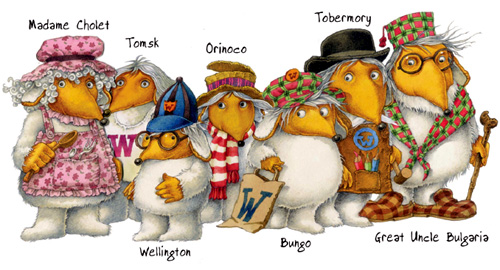
One of FilmFair Production's most iconic programmes, brought to life by Ivor Wood and his team, are the Wombles. Small, furry-like creatures who make the use of "things that the everyday folks leave behind" on their home at Wimbledon Common, London - without even trying, they helped to spread the importance of Recycling with fun characters and creative stories.

The original series aired in 1975 with voices provided by the versatile and enthusiastic Bernard Cribbens (Edward & Friends, Moschops) and have since spanned several memorable Albums - by composer / singer Mike Batt - a live-action film and a new series in 1997. As of 2010, the original books have been reprinted by Bloomsbury Publishing for new generations to enjoy. Not bad, eh? =)
How the Wombles originally looked in 1968!
Before television, however, The Wombles originally started out in a 1968 novel, written by Paris-born Elisabeth Beresford. She moved to London to start a family and, while working near Wandsworth Common, got the idea which would become her most famous creations. In fact, Orinoco was based off her own son Marcus…!

Elizabeth went on to write six novels in all, and having read the first out of sheer curiosity, I was very surprised to find major differences between the 13 stories in print and the 30-odd episodes of the original BBC series:

  • The novels are clearly aimed at a slightly older series, 10 to 12 years, with more depth in storytelling and humour than the TV episodes.
  • The first story begins with Bungo, the "star" of the novel, as he picks himself a name (like every good Womble, from Great-Uncle Bulgaria's map of the world) and then explores the Common with new friends Orinoco, Wellington and Tomsk while tidying up litter. It's through his curious nature that he has a run-in with a Dalmatian, helps mend the burrow with some ready-made concrete (discreetly paid for as Wombles never steal) and then bravely goes after Orinoco when he runs away from home.
  • The characters themselves are a fair bit cheekier to one another - and at times rather blunt, especially towards Tomsk for his stupidity (before he eventually gains their respect in an emergency), while Great-Uncle Bulgaria dished out a clout on the head or an aside remark here and there ("Bungo indeed - silly sort of name!").
  • There are also characters who weren't brought into the television series - such as Cousin Yellowstone, who helps Bungo find Orinoco in London - while Alderney and Shansi wouldn't appear until the 1997 series (although they were still present for the tie-in annuals and original books).
  • Like many novels there is a on-going storyline throughout - as the Wombles first have their burrow flooded and then caught in a heavy snowfall with a food shortage to boot. But all comes right in the end after the thaw when they head out for their annual Midsummer Night Party at Battersea Park.
  • And unlike the TV Series, the Wombles encounter with humans a fair bit more in the books. In fact, Great-Uncle Bulgaria shows his kinder side when he invites a lonely old gentleman, Mr. D. Smith, to their Womble Christmas Party…

And all this from one novel so far! The Wombles of Wimbledon Common have a great many more adventures in the remaining books as they travel the world, encounter Water-Wombles and eventually return home to their old burrow...

One wonders why they opted to revise the stories for a slightly younger audience when brought to television - not that anyone's complaining, heavens above! For me, when reading the books for the first time, it was more compelling to compare / recognise the differences and changes that were made. Even you would be amazed at how different the original story of "Orinoco and the Black Umbrella" differs to the version that was televised...

All in all, it is safe to say that I now find the Wombles delightful with either format. They're still fondly remember 40+ years later, whether for their music, the TV episodes or the original books, and show no signs of being forgotten about. The books are indeed worth your money if you're curious to view the original TV stories in a "new" (or should that be "old"?) light.

A slight update for 2010 - illustrated by Nick Price
 
LINKS OF INTEREST:

The Womble Burrow Fansite - featuring merchandise old and new!
Womble Stories - download a selection of audio stories from AudioGo.com


Saturday, 28 April 2012

The Flumps

Not many people today may know of "The Flumps" - but the "new generation" may recognise their theme tune, which was used for a series of Auto Trader adverts, no less…!
Narrated by English Actress Gay Soper, The Flumps was a stop-motion series created and written by Julie Holder in 1971 - like so many shows, old and new, it gained fame quite by chance. According to The A - Z of Classic Children's Television, Julie wrote a few "Flump" stories for her children, one of these her youngest brought to read out in school. The teacher was so impressed she told her husband, who just happened to be a BBC Producer, and snapped up the series for the Watch with Mother timeslot. And like many shows of its time, only one series of 13 episodes were ever made, but it still had a nice run of repeated airings until 1988.

The Flumps are…well..it's hard to say what they're meant to be. They fall in the same category as the Clangers or the Ping Wings - little fluffy beings who don't know what they are, but are happy all the same in their little run-down home. The family consist of Mother and Father Flump, Grandpa Flump (and his famous musical Flumpet) and the wee 'uns, Posie, Perkin and Pootle.

It's one of those "safe" shows where not much happens, with stories and songs told in a gentle, slow-paced manner - sort of a "day in the life" thing. However, combined with Julie's scripts, the singing / speaking performance of Gay Soper and the catchy theme tune by George Chisholm, the series eventually left a nice impact on me when I checked it out. Clear to see how it made itself a Cult Classic for those who do remember it.

In fact, it was charming enough to earn itself a DVD release in the new Millennium of 2000. Ideal for those who have little ones of their own to relive their memories =)

Even today, Miss Soper recalls the show well:

"...The story behind the voices.... I tried out various different accents - Scottish, Irish - before David Yates, the producer, made a choice of the slightly 'Northern' accent. The Yorkshire had some earthiness and warmth about it. I worked out a voice for each character and away we went!"

And how wee Pootle Flump's voice came to be:

"... Julie Covington was the real inspiration behind Pootle's muffled tones. She often did silly voices on stage during the rehersals of Godspell. It was really cute, so I immortalised it in the Flumps..."

"...one day back in 1989, a young man asked me: 'Could you do me a favour? Would you do a Flump voice for me?' I was totally floored, and then the Pootle voice came out! It soon caught on and every week hoards of 20-year-olds would ask me to do Grandfather or Perkin and so on. It was very strange."


LINKS OF INTEREST:

Tuesday, 6 March 2012

The Three Voices of The Magic Roundabout


The true beauty of Serge Danot's "Magic Roundabout" series was not just down to the stop-motion animation and design by Ivor Wood, but the genius in the writing - though not through the original French version...

Long story short, for those who don't know, the original series in black-and-white had enjoyed a cosy seven-year airing between 1964 - 71 in France until being brought over to Britain by the BBC. But since the original French scripts were not included to be translated, they decided to bring in Eric Thompson (of Playschool fame, including "The Magic Ball") to rewrite and narrate completely new stories.

So what we hear now from our childhood differs very much from the original French - which isn't a total loss since Eric's imagination with the on-screen action and characters have made the show what it is today: memorable, hilarious and slightly controversial in terms of its subtle drug references (according to the Beeb anyway, what with Dougal's Sugar addiction and the "stoned" bunny Dylan).

But long before the 2005 Movie came along, the original episodes have been fondly remembered by fans old and new from its dry humour and surreal visuals. However, Eric hadn't always been the voice of the characters we love...

The original gang - from 1970
In 1991, when the episodes were transmitted to Channel 4 (and later Cartoon Network), Nigel Planer (Grizzly Tales, The Young Ones) was brought in to rewrite and redub from Eric, who had by this time passed on. It is said that Nigel based Dougal's voice on British comedian Tony Handcock, which suited the shaggy dog's sarcastic nature quite nicely.

But then for reasons unknown the episodes had a third redubbing several years later, this time by Jimmy Hibbert (second only to Brian Trueman of Cosgrove Hall fame), who added a great sense of energy and zaniness in the remaining seasons "new" to the UK. Hibbert would be reunited with The Magic Roundabout again come the 2005 film and the CGI series that followed it, again as voice actor and script writer - and who very much captures the same air of Eric and Nigel's renditions as best he can in the episodes he penned himself.
Same Cast, New Look - their current CGI appearance
So whichever version of The Magic Roundabout you remember watching - old, new or something entirely different - you can view a sample of each here. Name your favourites!

BY ERIC THOMPSON


BY NIGEL PLANER


BY JIMMY HIBBERT


LINKS OF INTEREST:


Wednesday, 29 February 2012

The Adventures of Parsley

As I had already mentioned previous, spin-offs in animation have been quite common over the decades, so here's another example.
The Herbs was the creation of Michael Bond (of Paddington Bear fame), and was produced by FilmFair Productions as part of the Watch with Mother timeslot in 1968. Featuring the enthusiastic voice of Gordon Rollings, it focused on the goings-on in the Herb Garden of a country estate. In case you've never seen the series before, all the characters were personifications of a different herb; possibly the work of Nicholas Culpeper's 17th Century book, "Culpeper's Complete Herbal" inspired Michael to create the series.

Though it was written for a younger audience, the sophisticated, broad humour of the characters and Storyteller have made it a cult classic since. One only needs to hear the magic word "Herbidacious", and the memories of Sir Basil, Lady Rosemary, Bayleaf the Gardener, Constable Knapweed, and even Pashana Bedhi will come flooding back.

"I'm a very friendly lion called Parsley..."
But it was the animal characters that seemed to have more appeal than the humans - Parsley the Lion, Dill the Dog, Sage the Owl and even Tarragon the "Dwagon". So much so that, two years later, Michael Bond wrote a spin-off series with Parsley and Dill taking lead. However, The Adventures of Parsley differed from its predecessor in a few areas;

  • The episodes (all 32 of them) had a running time of 5 minutes compared to the 10 - 15 minute run.
  • The scenery was a little more basic, almost similar to the set design of "The Magic Roundabout" (considering Ivor Wood also worked on both shows).
  • The humour was much broader, often relying on clever word-play and puns-a-plenty.
  • Whereas all the characters had a signature song, Parsley and Dill were finally given "voices" of their own.

Here's a few personal choice episodes to view from the Playlist below. And if interested, you can get the Complete Herbs Collection on DVD to relive those memories =)


LINKS OF INTEREST:

Wednesday, 22 February 2012

Nellie the Elephant - Terry Ward

So far as I know, a small number of animated shows have been inspired by a popular song of a particular time. One example is the lesser-spotted Yakkity Yak, and the other is today's topic - Nellie the Elephant.

The original song dates back to 1956 - written by Ralph Butler and Peter Hart, it was first sung by child actress Mandy Miller for the BBC, and has since had countless versions recorded and sung by a great many number for children - including, most popular of all, the Toys Dolls's rendition.

So popular was the song that Terry Ward - of Junglies and Bananaman fame - created a series based on the song on behalf of FilmFair Productions. Written by Richard Everett and Bernie Kay, the series also featured the voices of Tony Robinson (Blackadder, Time Team, Maid Marian and Her Merry Men) and renowned Scottish Singer Lulu, who not only sung the theme tune but also voiced the titular character =)

As with the song, the series followed the adventures of Nellie as she tries to head back home to the jungle, all the while coming across and helping various characters on the way.

Below are several episodes to watch via the Playlist before checking out the other links below - either if you remember the series from your youth or just like the song =)


Monday, 2 January 2012

From Here to Timbuctoo

Happy New Year, everyone! Here's to many new, exciting things to come in 2012 for all of us =)

In honour of Ronnie Corbett (one half of UK double act The Two Ronnies) receiving his New Year's Honour, here's another notable series many may remember him from.


Following his success with the Mr. Men and Little Miss series, Roger Hargreaves also wrote another little series called Timbuctoo in the late 70's. The books tell the stories of a group of animals, each named after the sound they make - like Woof (a sort of Dog), Buzz (a sort of Bee), Squeak (a sort of Mouse), and so on. Each book follows a similar patten: some of them have odd little problems that they eventually overcome by even odder methods.


The books were later reprinted in the 90's (and re-illustrated by Roger's son, Adam) when an animated series was created by Flicks Films, who also worked on all the animated Mr. Men animated shows of the 70's and 80's respectively (although Terry Ward did have a hand to play with the 90's series by Marina Productions) as well as Bananaman in the 80's.

In comparison to the Mr. Men / Little Miss books, the original Timbuctoo stories were a little more simpler and didn't quite have the same spark of imagination. Luckily, when it came to adapting them for the animated series, writer Richard Everett (Busy Buses, Nellie the Elephant) was able to give them a much-needed boost in terms of story and character.

And of course, the narration and voices were provided by "Little Ronnie" himself, which is bit as charming as its rather unique theme tune...!


Saturday, 22 October 2011

Chuggington Sketches

Since I've not posted anything art-related here for....ever, I thought I'd remedy that once again!

After discovering and reviewing Chuggington, I thought I'd take a crack at drawing some of the characters, which I drew back in June earlier this year. Since each have more complex locomotive designs than what I'm used to seeing on British Railways and Heritage Lines, it was a fun challenge to attempt =)

Chuggington © Sarah Ball, Ludorum plc. I own nothing!


Saturday, 1 October 2011

Harry and Who

Since the final (current) series of Doctor Who premiers tonight in the UK, I thought I'd share a little something I did.

Last week my local Primary School invited me for an afternoon session, teaching the kiddies how to draw caricatures. Went far better than we all thought, so wouldn't be surprised if they decide to invite me back again ;)

For this session, I made a wise move by choosing two famous faces that the children would recognise and learn from as eamples. So here we have Matt Smith and Daniel Radcliffe (alias Doctor Who No. 11 and Harry Potter). Enjoy!

Friday, 9 September 2011

Fab Fables

The latest ING Direct adverts have gained my biggest interest over the last few months of their airing - whereas Hollywood and Television Shows are finding bigger, better and more exciting ways to construct CGI Animation (as demonstrated with the hilarious Compare the Meerkat adverts), the advertising agency responsible for these selections, BMB, have opted on hand-crafted puppets and live-action shots.

And they all look superb; each character looks distinctive and carefully built, with every ad told in a style of an Aesop Fable in link with ING Direct. Below is a behind-the-scenes video on how the ads are shot and hearing the crewmembers' inspirations and thoughts on them as a whole:


In fact, these delightful adverts remind me a lot of another forgotten BBC Series back in the 90's - Tales of Aesop, which was shot in the same wooden puppet style as by means of retelling the classic Aesop Fables, all narrated by Tom "Doctor Who #4" Baker =)


Thursday, 9 June 2011

BBC - Small People's TV - 1998

The first time I saw this Children In Need promo back in 1998, it made my heart sing. This was what truly made up the Children's BBC at the time: long before Digital TV, long before Sam and Mark, long before everything became outsourced and "American-imported".

THIS, my friends, was a perfect history of British Children's TV from the BBC, by the BBC. With as much of the "gang" included as possible - stop-motion, live-action and traditionally animated =)

I'd have loved to know who was responsible for the animation throughout here. Could be from their respective studios (who were probably still in business) at the time, but at a hunch I'd call on Cosgrove Hall for the stop-motion segments.

The little chap here, BTW, was played by one Scott Chisholm; in what would be his acting debut just aged 5, he would later expand his career in various other shows such as Casualty, The Giblet Boys and Things To Do Before You're Thirty.


But enough chatter. Here's the video below to enjoy and reminisce...thank lord that 83% of the shows included have already made their way to DVD... le sigh.


PAST HEADLINES:

Children's classics go back to the future
Children's TV trailer turns Scott into a star